
Escape To The Lakes
What would you give up to live in your idea of heaven? Money? A partner? Your children?
Luckily (?), I found myself without the latter two, so it was just a case of how much money I was willing to give up to live in the Lake District - and the answer was quite a lot.
I’d been making a tidy packet at Radio Merseyside in the 1980s by combining my pay-per-play salary (every time I got a piece on air I was paid £50 - and sometimes I’d have three stories a day) with the money Margaret Thatcher’s government was willing to pay me to NOT be an unemployment statistic.
This new job was a proper contract so, in that typical BBC way, paid much less… but it was in Cumbria.
Since I was born, I’d gone to the Lakes on holiday. It was only a couple of hours up the M6 from my home in Liverpool, yet it felt like another world (which is why Star Wars: The Force Awakens - aka One Of The Crap Ones - was filmed there). The closer you got to the Lakes, the more life’s troubles ebbed away as its loveliness seeped into your bones. Mountains and meres, pubs and more pubs. So when a contract came up at BBC Radio Cumbria, I leapt at the chance.
BBC job interviews - or “boards” as the Corporation likes to call them in a nod to fustiness and history - are made up of a panel of people who are there to suss you out. Usually there will be “the hirer” (the managing editor), the “willing lackey” (a producer who assumes that by volunteering to sit on “the board” they’ll have some say in who gets hired - they don’t), and, sitting at the end of the desk, a “lummox from HR” who everyone knows - including the lummox - is only there to make up the numbers.
And before you, the lummox from HR, complain: yes, I do realise HR does an important job and that you aren’t loved enough and nobody understands you, even though you fulfil a really crucial role and ensure the interview process is handled correctly - and that you’re on hand to spot any legal pitfalls.
But the one who holds most of the cards in any interview board is the one who speaks to you first: “the manager”.
If you are from a creative background, you’ll be used to this, but for those from a more formal career path it might surprise you to learn that BBC interviews for broadcast jobs often include a practical element - to make sure the interviewee is actually capable of:
speaking into a microphone
appearing on camera
writing in something akin to proper sentences
At Radio Cumbria’s HQ, high on a hill on the outskirts of Carlisle in a flat-roofed building called, aptly, Hilltop Heights, which also housed HMRC, I was ushered into a small room with a reel-to-reel tape recorder and a microphone and told to read the piece of paper in front of me. It was a two-minute news bulletin.
Every radio station liked to play the same trick on prospective employees - using a weird place name to see if you’ve done some homework. Radio Manchester used to check if you could pronounce Peover (not Pee-Over) and around the country the practicals would often contain stories involving places like Bicester, Cholmondeley, Frome, Fowey, Godmanchester, Omagh, Rievaulx, Towcester and Woolfardisworthy — even though, in the history of the known universe, very few stories have ever involved anything newsy happening in any of them. Especially Woolfardisworthy.
Meanwhile, in a little room in Carlisle:
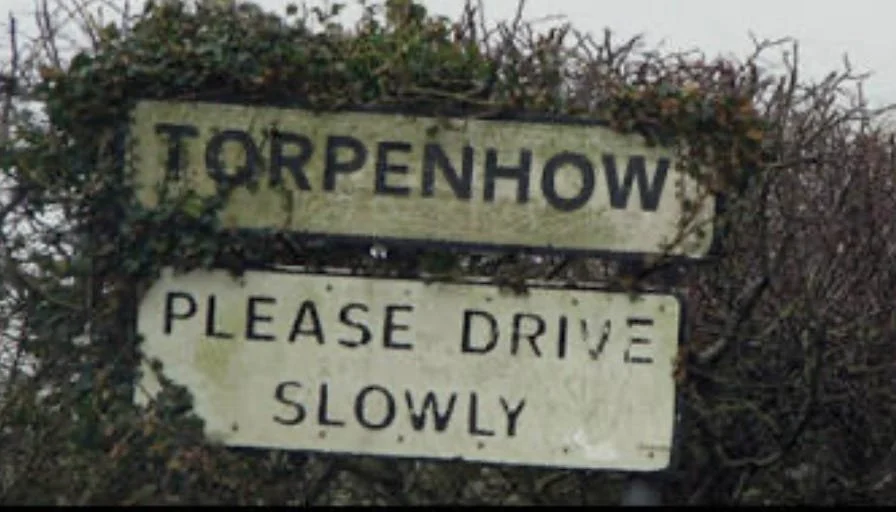
“Two people have been taken to hospital after a house fire in Torpenhow.”
On paper it looked easy-peasy - “Tor-Pen-How” - but in reality it was pronounced Tr’pen’er. Get it wrong and you’d be shown the door. Luckily I’d done my homework and the job was mine. And although it was only a four-week contract, I spent a good proportion of my yet-to-be-earned wages on a leg of lamb and a few pints of Sneck Lifter in my favourite pub in Great Langdale on the way home.
I was being employed for a very specific reason. Radio Cumbria had a leak in the roof. Quite a bad leak. So bad, in fact, that the roof had to be taken off and replaced and nobody was allowed in while the work was being done. They were treating it so seriously you’d think it had something to do with asbestos rather than a drop of rain - but when I made that joke in the pub one night everyone went quiet and looked away. I was a little concerned until the next day when the heavens opened and one of the engineers rushed in with a huge tarpaulin and threw it over the mixing desk I was sitting at.
My job was to “drive the desk” - to play in records, tapes and jingles while the presenters were out presenting “on the road” until the new roof was completed. All day long I’d line up the next track, waiting for the presenter to introduce it - at which point I’d quickly open the fader and play the song. Sometimes it was the right song; often it wasn’t. Sometimes I’d start the track too early and at other times I’d be watching Wimbledon on the studio TV screen and realise everything had gone quiet because I’d missed my cue. It would only be a few seconds, but it taught me a valuable lesson: time, on the radio, moves at a different speed to real life. You can fit huge amounts of words into five seconds and if you don’t…
the silence
seems to last
a lifetime.
The music Local Radio played was, uniformly, awful. Every track came from the 1950s - presumably because that was the music the average Radio Cumbria listener preferred. Or the station’s manager. One of the two. I was 22 years old and Paul Anka and The Flamingos weren’t my music of choice, so I decided to introduce the good folk of Cumbria to something a bit more modern. The presenter would be expecting a Connie Francis track to fire up off the back of the news and instead I’d whack on It’s A Sin by Pet Shop Boys. The listeners never complained but the boss did - especially when I stuck on the subtly titled I Want Your Sex. Cumbria, I was told, wasn’t yet ready for George Michael.
It turned out to be a short stint in the heaven of the Lakes. As soon as I’d got myself sorted into a flat in Carlisle and had a couple of weekends pottering around Keswick and Ambleside, another job offer came up. Middlesbrough would prove to be a very different vibe to the Lake District but an important step in my continuing quest to work in every Local Radio station in the north of England.
It was time to move on - and I never did get to cover any stories in Torpenhow.