
My Life With Murderers (& Other Occupational Hazards).
I’ve lost count of the number of murderers I’ve shared a room with. Rapists, fraudsters and gangsters too. Most of the time they ignore the reporters sitting on the press benches in a court room but occasionally they’ll peer at you as if they’re looking at an animal in a a zoo - I’m never sure if they realise that they’re the ones on the wrong side of the toughened glass cage of the dock.
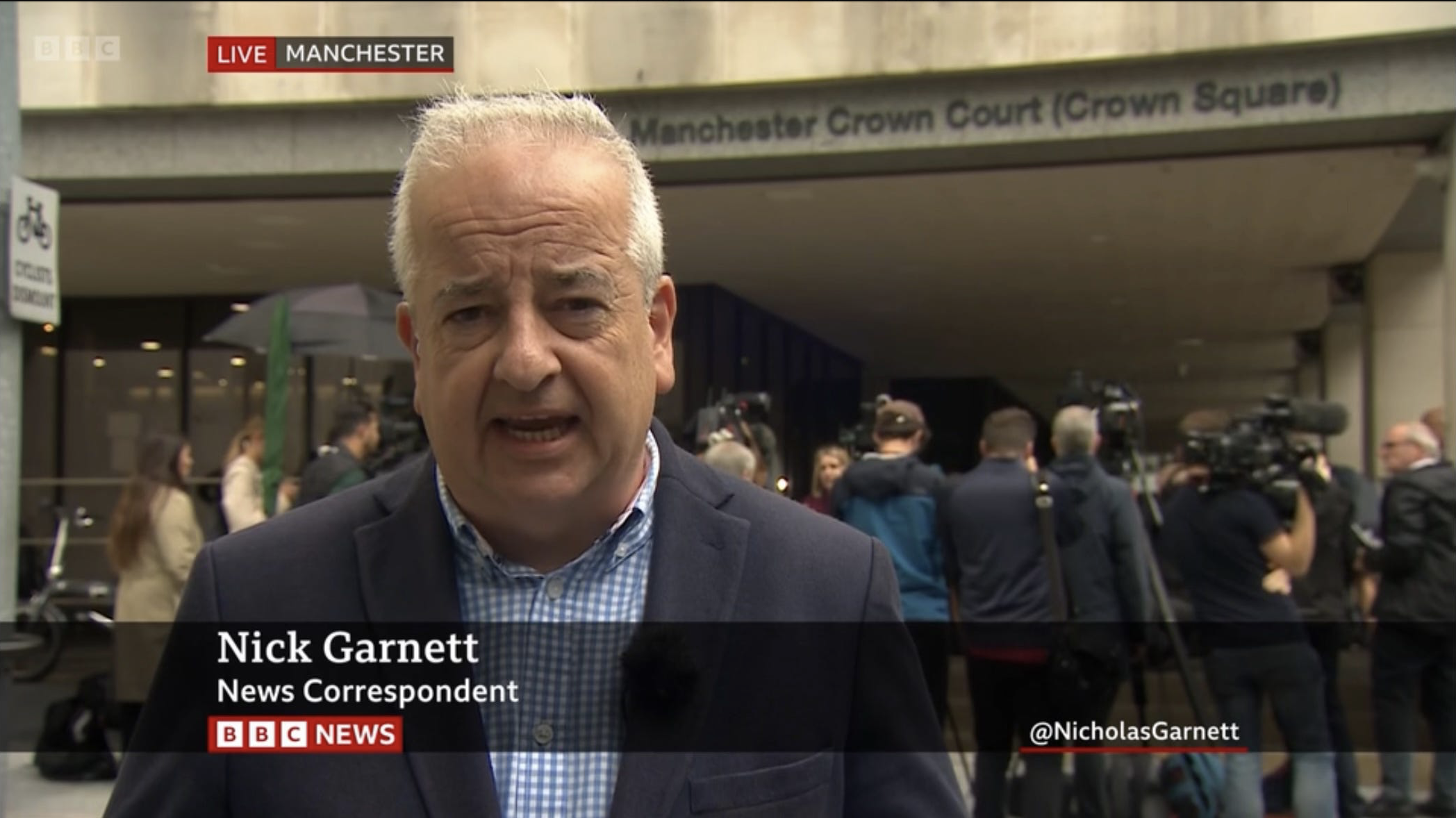
Court stories always get good numbers. Viewers, readers and listeners love a good trial. That’s why news organisations send reporters to cover them but it’s not a cheap decision. Thinking about it in purely economic terms, when the media cover a trial they’re committing a lot of resources for an indefinite period of time. Some cases are over in a day or two, others can feel almost endless. The days are, mostly, gone when a reporter would go to every single day of a trial but, at the very least, a commitment to cover a court case involves the following:
One or two days reporting on the opening of the trial.
Another two days covering the ‘big witness’ evidence.
The defence case - especially if the defendant goes into the witness box.
Closing submissions from each side.
The judge’s summing up.
The jury deliberations.
Sentencing (if they’re convicted).
That’s a LOT of commitment and expense. And that’s just the trial: there’ll be background work going on - filming with victims, the obligatory ‘piece to camera’ recorded at an important location and the editing of all the material so it’s ready for whenever the trial ends. It’s a massive undertaking and it’s why news organisations pray there’s never a mistrial -which would mean the whole thing has to start again from scratch!
The whole court system is complicated. Most of us don’t really understand how it all works so I’ll try and explain what happens:
A serious crime is committed.
The police investigate.
Someone is arrested and questioned.
The police go to the CPS - the independent Crown Prosecution Service - who consider whether or not there’s enough evidence.
The CPS charge the person.
The case goes to a magistrate’s court and, because it’s a serious issue, it gets bumped up to Crown Court and a trial date is set.
When the case opens, the jury is selected and the trial begins.
The prosecution opens its case with a summary of what it says happened. ‘The Opening’ is designed to capture a jury’s attention (and the media’s) and will throw up a few headline-grabbing turns of phrase.
Then the prosecution lays out the detailed case against the defendant. This is usually the most lengthy part of a trial.
The defence then puts its side of things forward, hoping to plant enough seeds of doubt for a jury to be unable to be certain the defendant ‘did it’.
Finally, the judge sums up both sides of the case and sends the jury out to decide.
At which point…
12: the
world
stops
…dead.
It’s like that film, The Day The Earth Stood Still, but much, much slower.
The jury spends as long as it needs to look at the evidence while everyone else worries about running out of time in the car park and who’s going to pick up the kids from school. Social arrangements get thrown out of the window when the jury come back after three days only to ask a question about a bit of evidence that was heard on day two of a three week long trial. Everyone tries to work out if this means they’ve nearly finished deliberating or are only just starting but the truth is - nobody has a clue.
As a reporter you wait patiently for the inevitable to happen - not for the jury to return with a verdict, but a phone call from the newsdesk which always goes like this:
“Hi. This court case you’re covering. When are we expecting the jury to come back?”
To which my stock response is “Just before the end of the 6 o’clock news on Friday evening.”
If they’ve asked a stupid question, I’ll give them a stupid answer.
The truth is that
a: how would I know? I’m not sitting with the jury as they work out what really happened and
B: courts hardly ever sit on a Friday evening because everyone knows they finish earlier in the day than house builders or presenters of breakfast radio and television shows (which, trust me, is really saying something).
Sometimes it’s the events that happen around court cases that make them interesting.
Hull
So, there I was, driving to Hull and back every day for weeks while two footballers, Lee Bowyer and Jonathan Woodgate, stood trial accused of beating up a young man in the centre of Leeds. Mr Bowyer would be acquitted of both charges while Woodgate would be convicted of affray and sentenced to 100 hours of community service. He was cleared of causing grievous bodily harm.
The daily drive along the car park, aka the M62, took me across the Pennines. Chased up and down the hills by lorries on their way to the East coast, every morning I’d get blinded as the sun came up. Ray-Bans on, I’d turn left opposite the marina and into the multi story near the court room which, at the turn of this century, had a little hut where a man sat waiting to take your money for the day’s parking. On the first day of the trial, I wound my window down to be greeted by the man in the hut with the words,
“You here for the trial then? You with the media?”
I was staggered. I wondered if I had a PRESS sticker on the car or was wearing a trilby and had a pen stuck behind my ear which made it obvious I was a reporter.
“Why do you say that?”
“Well,” he said in as patronising way as he could. “It’s December and we don’t wear sunglasses in Hull in December.”
Harold Shipman
When Harold Shipman first appeared in court I was there, watching. He would become known as one of the most prolific and appalling mass murderers of modern times even though, on the face of it, he just looked like a a grumpy, arrogant old fool. He’d been charged with murdering 81 year-old Kathleen Grundy and forging her £350,000 will. His demeanour was very similar to that of my own GP at the time - slightly musty, a bit befuddled, a scruffy beard, little glasses and a fair isle tank top but it was all a front. He was a conniving, immoral, devious murderer. The press-pack was out in force. The public gallery and press bench at the brand new magistrate’s court at Ashton-under-Lyne was raked like an amphitheatre and on this day it was rammed to the gunnels from the moment the court building opened.
It’s always a bit of a gamble when you turn up at court because you never actually know what time someone will be brought up into the dock - just like TV news bulletins, the running order can always change. The magistrates decided to get a quick “up and down” case out of the way for starters before they went on to the main course.
On any other day the first to be brought up to the dock - a pathetic young man charged with urinating in a public place at the weekend - would have been fined £50 plus costs and told not to do it again but on this particular day, Tuesday the eighth of September 1998, things were different because he was appearing just before a mass murderer was due in court. As the magistrates addressed him and told him his behaviour fell below the standards by which he should live his life, he happened to turn round and face us. He froze. The whole court was full of reporters from radio, TV, newspapers and press agencies. The man almost urinated in a public place again - an act that would have undoubtedly doubled his fine. A very private moment of drunken stupidity was recorded by the world’s media as it warmed up its shorthand ahead of the main event. Head hanging lower than it ever had before, the man skulked away at the end of his short hearing.
As soon as he was dispatched back down below it was time for Shipman.
Four security men surrounded him as he was brought up although he looked so feeble, so meek and mild, he didn’t look strong enough to fight his way out of a children’s play pen. He peered out of the glass walled dock as if he was searching for someone. He stopped as he faced me. He mouthed the words,
“Are you ok?”
I froze.
Harold Shipman would eventually be convicted of murdering fifteen of his patients but he probably killed around two hundred and fifty people in his care during his ‘career’. Yet again, I was spending my time consorting with the people my mother warned me not to and I was painfully aware that all eyes were on me, not just Shipman’s.
Kevin Bocquet from The BBC was on the wooden bench to one side of me. David Ward from The Guardian was on the other. Both men gently slid in opposite directions as they shifted away from me, leaving me more alone than I’d ever felt before. Nobody wanted to be near me.
“Yes,” I mouthed back.
“What the…?” whispered Bocquet.
The weirdness of the moment was interrupted by case getting underway. Shipman turned to face the magistrates.
The charges were read out to the court and, after a couple of minutes of discussion with lawyers, the magistrates huddled together for a minute to work out what to do next. It gave Shipman the chance to turn round and stare at me again.
“More clothes.” He rubbed his fingers on the grey prison issue sweatshirt he was wearing.
David Ward and Kevin Bocquet slid so far away from me they almost fell off the end of the polished oak benches.
Shipman was still there, staring at me.
“Love you.”
I was about to commit the same act as the first bloke in court and wet myself when I realised Shipman was looking slightly above me. Everyone nearby noticed at the same moment and we all turned round. He wasn’t looking at me! In the middle of the gaggle of reporters sat his wife, Primrose. As he was led back down to the cells she stood, called goodbye to him one more time, blew him a kiss and then made for the exit as quickly as she could.